
Company news
We Built a CMS in Public — Here's What We Learned
Building Contensa in public meant shipping imperfect things, getting real feedback early, and learning faster than we ever could have in stealth. Here's the honest story.
•
9 min read
The way we build content infrastructure is changing faster than most teams realize. Here's where it's heading — and what it means for developers, content teams, and the tools they use.
Michael Chen
AI/ML Engineer

The way we build content infrastructure is changing. Not incrementally — fundamentally. The assumptions that have governed CMS design for the past decade are being invalidated, one by one.
Here's what's changing, why it matters, and where it's heading.
The foundational assumption of every CMS built in the last 20 years is this: humans design the content structure.
A developer opens the CMS admin, creates content types, adds fields, configures relationships, and publishes the schema. This is treated as necessary work — the unavoidable cost of having structured content.
This assumption is breaking down. Not because the work is unnecessary, but because AI can do it better and faster than humans can.
When you describe what you're building in plain language — "a product catalog with variants, pricing, and related blog posts" — an AI can generate a well-structured content model in seconds. The field types are correct. The relationships are properly modeled. The naming conventions are consistent.
The manual schema design step is becoming optional. And when a step becomes optional, it eventually becomes obsolete.
The interface for content infrastructure is changing from configuration UIs to natural language.
Instead of clicking through field configuration panels, you describe what you need. Instead of writing schema definitions in code, you explain your requirements in plain English. The system translates your intent into structure.
This is not a small UX improvement. It's a fundamental change in who can participate in content infrastructure decisions. When schema design requires clicking through complex UIs or writing TypeScript, it's a developer-only activity. When schema design requires describing what you're building, content strategists, product managers, and even clients can participate.
The democratization of content infrastructure is happening now.
Traditional CMS APIs are static: you define your schema, and the API reflects that schema. If you add a field, you update the schema, and the API updates.
The next generation of content APIs will be dynamic: the API adapts to your query, not the other way around. You ask for exactly the data you need, in exactly the shape you need it, and the system figures out how to deliver it.
GraphQL was the first step in this direction. AI-powered query optimization is the next step. Instead of writing complex queries to get the data you need, you describe what you need and the system generates the optimal query.
This matters because it removes the impedance mismatch between what content teams create and what developers consume. The API becomes a translation layer that both sides can work with naturally.
Current CMS platforms are reactive: a human creates content, the CMS stores it, the API delivers it. The system does what it's told.
The next generation of content platforms will be proactive: the system suggests content that needs to be created, identifies gaps in coverage, flags content that's becoming stale, and generates first drafts for human review.
This is already happening in early forms — AI content suggestions, automated SEO recommendations, content performance analytics. But it's going to go much further.
Imagine a CMS that notices your product page hasn't been updated in six months, checks your product database for changes, and drafts an updated version for your content team to review. Or a CMS that identifies that you have strong content coverage for enterprise customers but weak coverage for SMBs, and suggests a content plan to address the gap.
This is not science fiction. The technology exists. The integration work is what's left.
The role of developers in content infrastructure is changing.
Today, developers are the primary architects of content structure. They design schemas, write API queries, maintain TypeScript types, and handle schema migrations. This is significant work that consumes significant time.
As AI takes over more of this work, developers will shift from being content infrastructure builders to being content infrastructure orchestrators. Instead of building the schema, they'll define the requirements and let AI build it. Instead of writing API queries, they'll describe the data they need and let AI generate the query.
This is not a threat to developers — it's a shift in where their expertise is most valuable. The developers who thrive in this environment will be the ones who understand how to work with AI systems effectively, how to evaluate and refine AI-generated outputs, and how to build systems that leverage AI capabilities.
The developers who struggle will be the ones who resist the shift and insist on doing manually what AI can do better.
Content teams are gaining capabilities they've never had before.
The ability to participate in content structure decisions — without needing a developer to translate their requirements into schema definitions — is genuinely new. Content strategists who understand their content needs can now express those needs directly to the system.
AI-assisted content creation is also changing what's possible. Not replacing human creativity, but augmenting it. First drafts that take hours to write can be generated in minutes. Translation that requires professional translators can be assisted by AI. SEO optimization that requires specialist knowledge can be automated.
The content teams that will thrive are the ones that learn to work with AI as a collaborator — using it to handle the mechanical work while focusing human creativity on the work that actually requires it.
The CMS market is being disrupted from two directions simultaneously.
From below: no-code and low-code tools are making it possible for non-technical users to build content-driven applications without a traditional CMS at all.
From above: AI-native platforms are making it possible for technical teams to build content infrastructure dramatically faster than traditional CMS platforms allow.
The traditional CMS platforms — Contentful, Sanity, Prismic, and others — are adapting. They're adding AI features, improving developer experience, and expanding their capabilities. But they're adapting to a world that's changing faster than their adaptation.
The platforms that will win are the ones built for the AI-native world from the ground up — not the ones retrofitting AI onto architectures designed for manual workflows.
This is not a 10-year prediction. It's happening now.
2024-2025: AI content generation becomes mainstream. Most CMS platforms add AI writing assistance. Early AI-native CMS platforms emerge.
2025-2026: AI schema generation becomes reliable. Teams start using AI to generate content models rather than building them manually. The time savings are significant enough to drive adoption.
2026-2027: AI-powered content operations become standard. Proactive content suggestions, automated gap analysis, and AI-assisted content planning become expected features.
2027+: The distinction between "AI-assisted" and "standard" content infrastructure disappears. All content infrastructure is AI-native. The question is not whether to use AI, but how well your platform uses it.
If you're a developer or technical leader responsible for content infrastructure:
Evaluate your current CMS against AI-native alternatives. The time savings from AI schema generation are real and significant. If you're spending significant developer time on content modeling, you're leaving efficiency on the table.
Invest in understanding AI-native workflows. The teams that learn to work effectively with AI-generated content infrastructure now will have a significant advantage over the teams that learn later.
Don't over-invest in manual processes. If you're building elaborate manual workflows for content modeling, schema management, or content operations — ask whether those workflows will still make sense in two years.
Start experimenting. The best way to understand what's possible is to try it. Run a project with an AI-native CMS. Measure the difference. Let the results inform your decisions.
The future of content infrastructure is AI-native. Manual schema design, manual API configuration, and reactive content operations are being replaced by AI-generated schemas, dynamic APIs, and proactive content systems.
This is not a distant future. It's happening now, in production, at teams that have made the shift.
The question is not whether this transition will happen. It's whether your team will be ahead of it or behind it.
Contensa is building the AI-native content infrastructure of the future, available today. Start your free workspace and see what's possible.
Building Contensa in public meant shipping imperfect things, getting real feedback early, and learning faster than we ever could have in stealth. Here's the honest story.
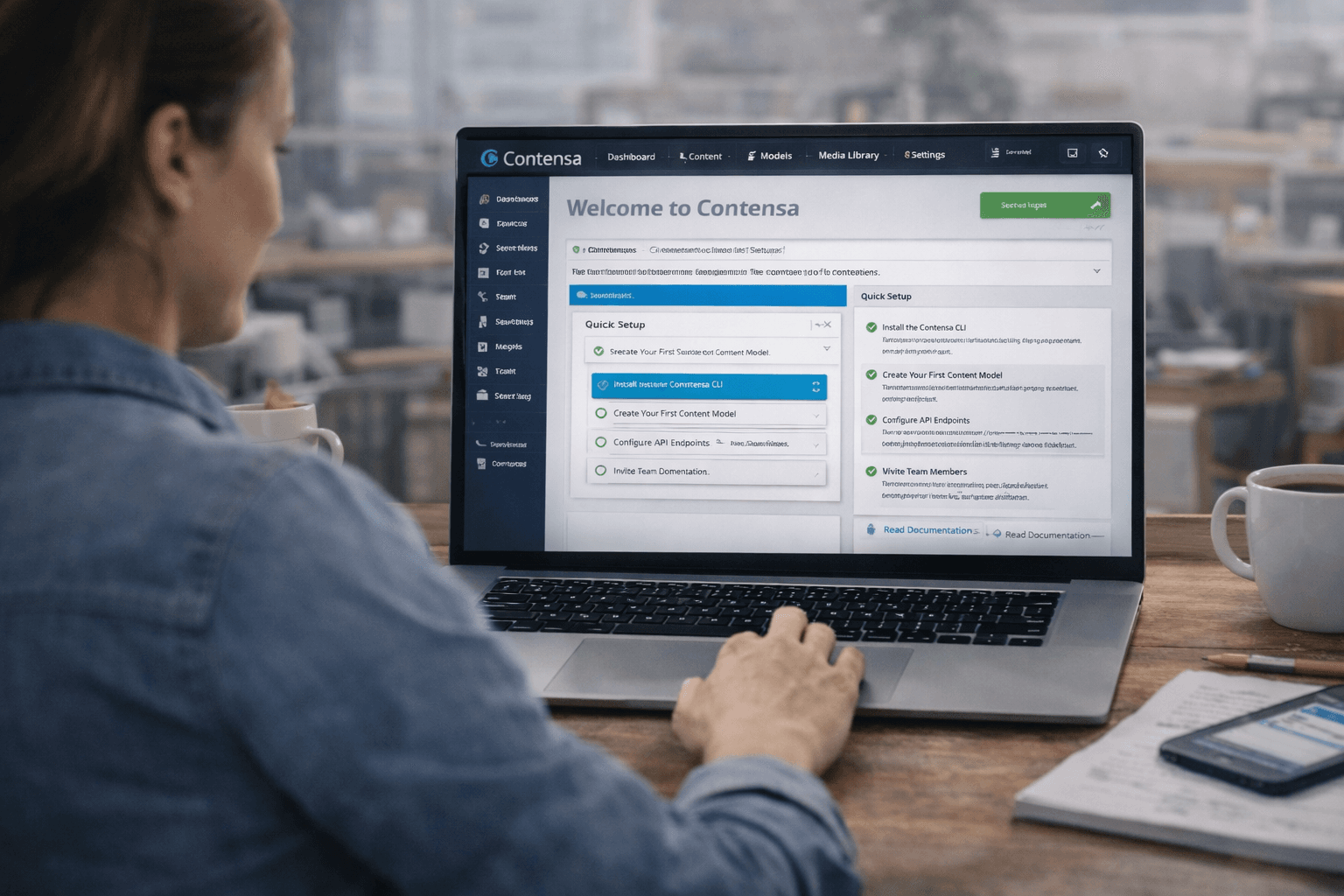
Learn how to set up Contensa CMS in minutes with this step-by-step guide covering installation, configuration, and fetching your first content.
Discover how to leverage Contensa's AI content generation features to streamline your workflow and create high-quality content faster.